Learn about the Penny Pledge - our $0.01/kg promise to fund the ‘That’s Clean’ campaign.

WHAT A U.S. HYDROGEN PLATFORM MUST DO

(Series Part 4: “Where the Hydrogen Industry Goes Next”)

If the first three posts showed the gaps we’re facing, this one is about the path forward.
Because after watching Europe launch the first real hydrogen marketplace, it’s clear what the U.S. needs next:
Not another hub.
Not another grant cycle.
A national hydrogen platform built for actual deployment.
Something that connects producers, fleets, OEMs, cities, financiers, utilities, and SMEs into one living ecosystem.
And here’s the truth:
We already know exactly what that system must include.
1. A Supply & Demand Engine (Not a Directory)
We need a real-time, verified map of:
• suppliers
• buyers
• station developers
• logistics pathways
• infrastructure bottlenecks
• regional volume needs
This is shown in your first map infographic.
The U.S. doesn’t have this.
The EU now does.
Without this visibility, deals take months instead of days.
2. A Bankability Layer
Our projects don’t fail because of hydrogen, they fail because of uncertainty.
A U.S. platform must include:
• partner scoring
• technology readiness checks
• financial reliability indicators
• compliance & document review
• delivery history
• business stability
• completeness of information
Exactly what your “Bankability Engine” infographic covers.
Why?
Because without trust, nothing moves.
3. A Project Workflow Engine
Developers need a place where projects can move from:
Inception → Planning → Procurement → Post-Contract
in one continuous workflow.
This is the only way to stop losing months to PDF exchanges, outdated spreadsheets, and email chains.
Your “H₂ Project Planner” graphic shows the full lifecycle.
4. A Go/No-Go Decision Layer
No more $150K feasibility reports that take 6 months and are outdated before they’re finished.
A real U.S. marketplace needs:
• validated partner data
• incentive modeling
• CAPEX/OPEX inputs
• carbon intensity scoring
• community alignment checks
• regulatory screening
• clear action pathways (Proceed / Pivot / Pause)
Your Go/No-Go system shows this perfectly.
The market doesn’t need guesses, it needs clarity.
5. A Clean-Fuel Marketplace That Actually Closes Deals
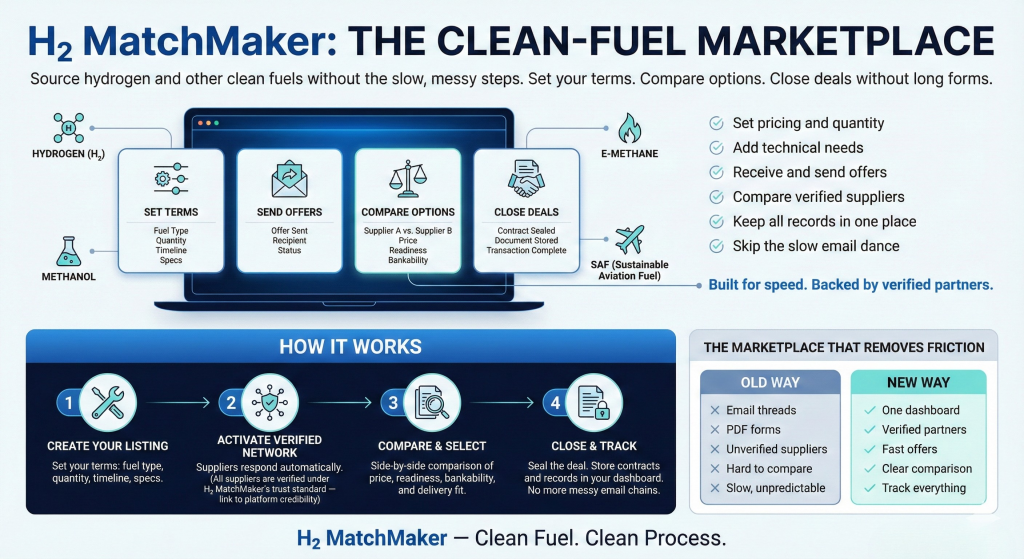
Hydrogen.
e-Methane.
Methanol.
SAF.
All in one place.
All verified.
All comparable.
All trackable.
That means:
✔ set your terms
✔ send offers
✔ compare verified suppliers
✔ close deals
✔ store records
Your “Clean Fuel Marketplace” visual nails this.
This is how we cut transaction times by 90% and remove “email ping-pong” from procurement.
6. Real-Time Market Pulse
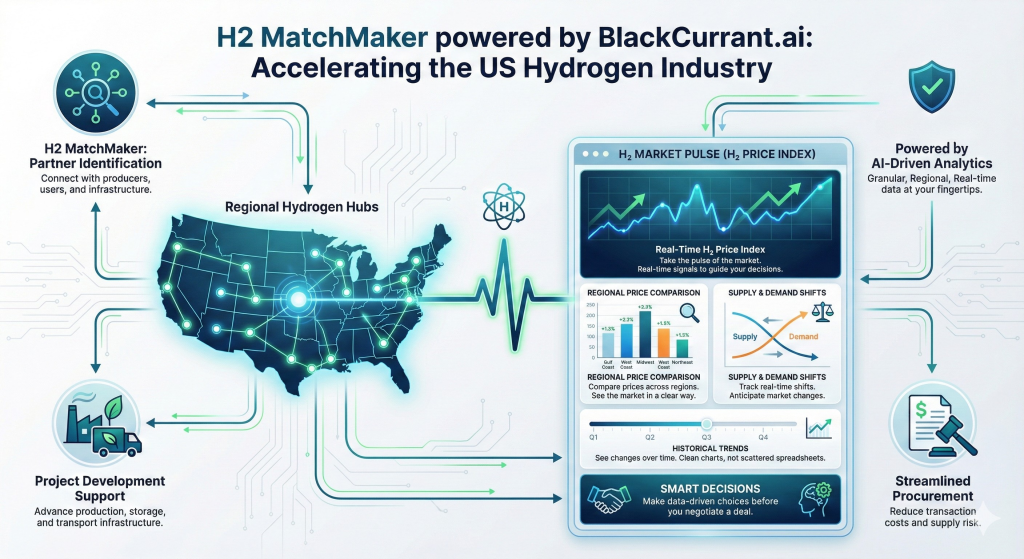
We need a platform that tracks:
• regional price changes
• supply/demand shifts
• capacity movements
• infrastructure gaps
• incentive impacts
• future trend modeling
Your “H₂ Market Pulse” infographic shows what that looks like:
A live heartbeat of the U.S. hydrogen economy.
This is what financiers want more than anything else.
7. An Optimizer Engine for Pathway Modeling
Every project needs to test scenarios:
Path A
Path B
Path C
The system must model:
• returns
• volume
• price strategy
• route planning
• downtime
• risk
This is how producers, fleets, cities, and station builders make real decisions.
Your “H₂ Optimizer Engine” graphic makes it obvious:
Without modeling, we’re guessing.
With modeling, we’re competing.
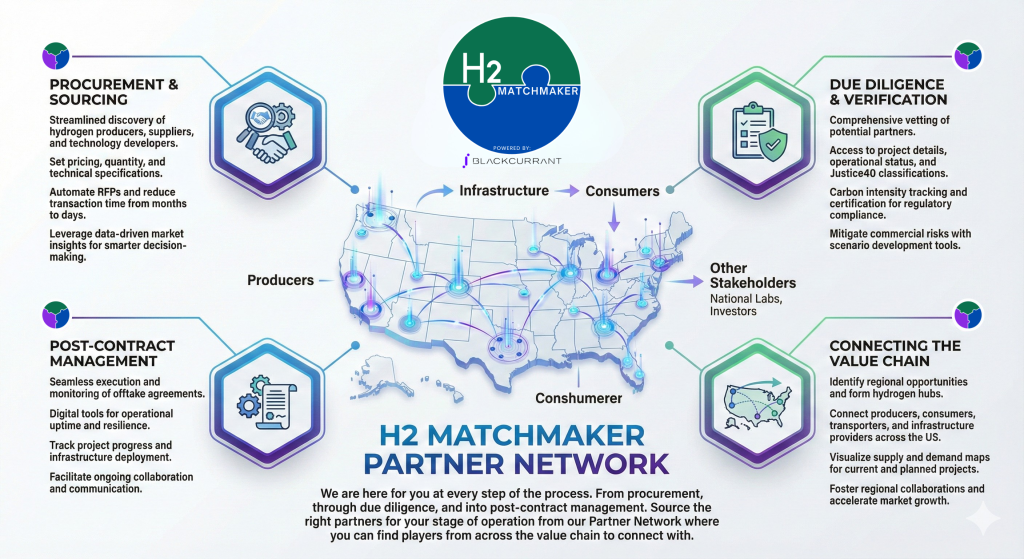
8. A National Partner Network (Verified, Not Voluntary)
We need one trusted ecosystem that includes:
• producers
• OEMs
• EPCs
• station developers
• fleet partners
• energy storage partners
• national labs
• financiers
• community organizations
• SMEs
Your Partner Network graphic shows what this looks like:
one place where all value-chain players meet and move.
This is how orphaned projects get adopted again.
9. A Post-Contract Execution Layer
The U.S. has thousands of megawatts “announced” — but very few actually operating.
A real platform must support:
• operational monitoring
• uptime and resilience
• collaboration threads
• document management
• change tracking
• community reporting
• ESG transparency
Your post-contract visuals show what this looks like.
This is how we stop losing projects in the last mile.
The Blueprint Is Already Here
The U.S. doesn’t need to guess anymore.
We don’t need to reinvent the wheel.
We don’t need to wait for perfect federal alignment.
We just need to build the platform that connects the entire ecosystem
and we already know exactly what it must do.
“Hydrogen doesn’t need more announcements, it needs a backbone. Build the system, and the industry will move.”