Learn about the Penny Pledge - our $0.01/kg promise to fund the ‘That’s Clean’ campaign.

BEV vs. FCEV: Stop Fighting Physics

Opinions & Perspectives Strategic Advice
You are asking the wrong question. It’s not about which technology wins the culture war. It’s about which one doesn’t bankrupt your logistics model.
I hear it every week. “AJ, should we go electric or hydrogen?” Stop.
I hear it every week. “AJ, should we go electric or hydrogen?” Stop. That’s like asking if you should use a screwdriver or a hammer. They do different things. The market loves a binary choice, pitting Tesla stans against hydrogen diehards. It is noise. If you run a fleet, you don’t care about ideology. You care about uptime. The signal you are missing is energy density per dollar of cargo revenue. If you ignore this, you lose money.
The Weight Penalty
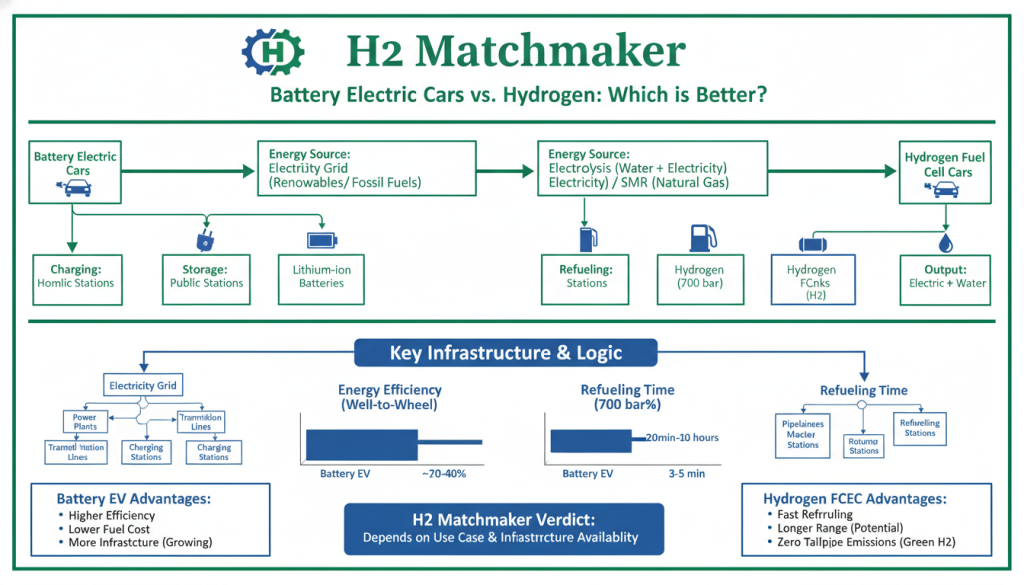
Batteries are heavy. This is a physics problem, not a technology problem. To move a Class 8 truck 600 miles, you need a battery pack so massive it eats into your legal payload limit. You are literally paying to haul the fuel system. That is bad business. You trade profit for range.
Hydrogen stores energy in a tank. It is light. You keep your payload capacity. You keep your revenue per mile. If you haul heavy things over long distances, batteries fail the math.
The Grid Reality Check
Go look at your facility’s power capacity. Now calculate what happens when 50 trucks plug in simultaneously at 6:00 PM. You don’t just need chargers. You need a substation. The local utility will tell you that upgrade takes five years and costs millions. You do not have five years.
Hydrogen refueling mimics the diesel experience. Fast. Scalable. It removes the reliance on a grid connection that wasn’t built for industrial-scale charging.
The Verdict is in the Duty Cycle
Stop looking for a silver bullet. The answer is split.
If your vans do 100 miles a day delivering packages and park at night? Buy batteries. The TCO is unbeatable. It works. Don’t overcomplicate it.
If your rigs run 24/7, haul steel, cross state lines, or operate in freezing temps where batteries lose 40% efficiency? Hydrogen is the only option that keeps the wheels turning. A battery truck sitting at a charger for four hours is a truck that isn’t making money.
Morning Move
This morning, pull your fleet data. Separate every vehicle by daily mileage and average payload weight. Anything under 200 miles with light loads goes to the BEV column. Anything over 400 miles with heavy loads gets flagged for Hydrogen pilot programs. Stop trying to force a single solution on a mixed-use fleet. Join H2Matchmaker