Learn about the Penny Pledge - our $0.01/kg promise to fund the ‘That’s Clean’ campaign.

When Fuel Fails, the Grid Fails

What Hawai‘i Just Taught Us About Trust in Clean Power
In late 2025, Hawai‘i Electric Industries and Pacific Current filed a lawsuit that revealed a serious problem inside the state’s energy supply chain. The Hamakua power plant, a 60-megawatt facility that supplies up to one-third of Hawai‘i Island’s electricity, lost both of its LM2500 gas turbines because the plant received tainted fuel.
These engines normally last decades.
They power naval ships around the world.
They are built to take heat, stress, and heavy use.
But they cannot survive bad fuel.
The lawsuit says the naphtha delivered to Hamakua contained more than three times the allowed alkali metals. These metals stripped off the protective coating inside the turbines and caused them to break down from within. The damage was so extreme that long-time GE technicians said they had never seen anything like it.
Hamakua was forced offline.
The island lost a major part of its firm power.
Hawai‘i had to bring in other sources and pay higher costs.
And none of this happened because of technology failure.
It happened because of trust failure.
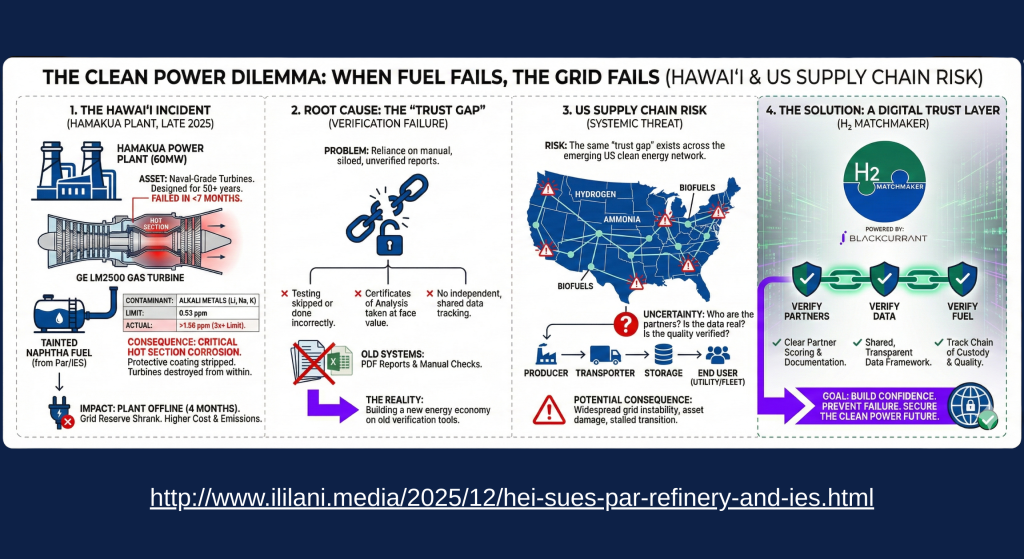
The real problem: no shared way to verify partners and fuel quality
The case highlights something the entire clean-power industry struggles with:
- Fuel quality reports were taken at face value.
- Testing was skipped or done incorrectly.
- No independent verification existed.
- No shared data or tracking system was in place.
Hamakua wasn’t alone. Kaua‘i’s utility saw the same corrosion at the same time. Even the refiner’s own turbines were damaged.
When a supply chain breaks, the grid breaks with it.
This should concern everyone working on hydrogen, renewable fuels, or clean-power systems. Clean power depends on trust. Trust depends on verification.
And right now, most energy projects rely on manual checks, siloed reports, and old systems that do not catch problems early enough.
What this means for hydrogen and clean fuels
Hydrogen is not the issue here.
Naphtha is not the issue either.
The deeper story is this:
Any fuel (hydrogen, ammonia, methanol, biodiesel, or transitional liquids) needs a trusted system around it.
A system that checks partners.
A system that tracks the chain of custody.
A system that verifies what is being delivered.
A system that alerts teams when something looks off.
Without that, even the strongest technology can fail.
And as more fleets, cities, ports, and utilities move toward hydrogen and clean fuels, the risk only grows. We are building a new energy economy on old verification tools. That cannot continue.
Why this matters for the future of clean power
Hawai‘i’s experience makes one thing clear:
A clean-power future must include a trust layer.
Not optional.
Not “nice to have.”
Essential.
That trust layer needs to confirm:
- Who the partners are
- Whether they meet standards
- Whether the data is real
- Whether each step in the chain is safe and consistent
This does not exist in most parts of the industry today.
And that is exactly the gap H₂ MatchMaker is designed to fill.
How H₂ MatchMaker can help prevent failures like this
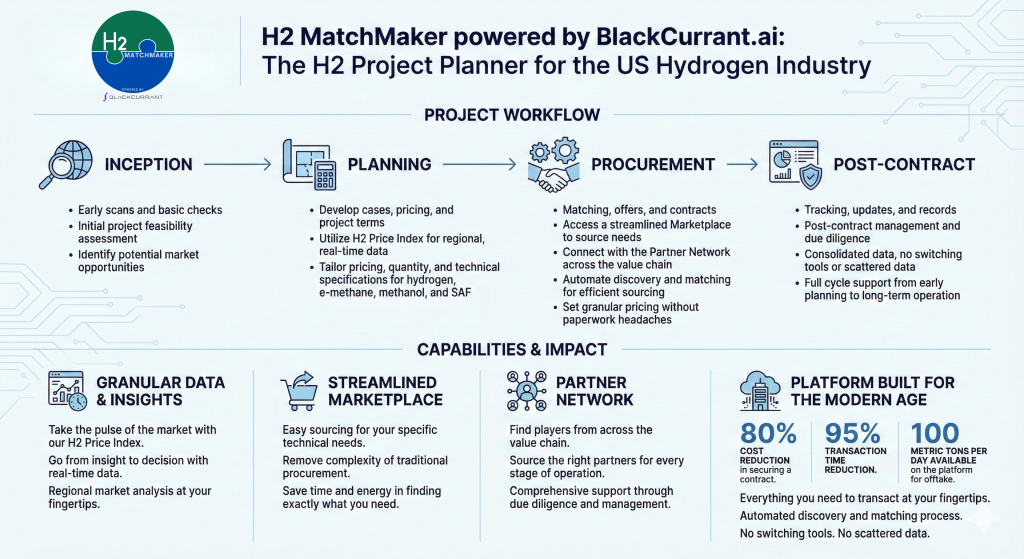
The platform brings three pieces together:
1. Verified partners and clear scoring
Companies are checked, documented, and scored so fleets, cities, and utilities know who they can rely on.
2. A shared system for data and quality
Fuel partners, stations, developers, and OEMs can operate inside one transparent framework instead of siloed spreadsheets and unverified reports.
3. A path that moves from learning → checking → real deployment
Teams don’t guess.
They learn what matters, understand the risks, and then work with trusted partners.
This is not about hydrogen alone.
It is about creating a safer and more reliable clean-power system across the board.
Hawai‘i gives us the warning. The industry must respond.
The grid went down because trust broke down.
This moment should push the industry to raise its standards.
Not with more paperwork.
Not with more committees.
But with a shared, simple approach:
Verify the people.
Verify the data.
Verify the fuel.
Then move forward.
Clean power is ready.
The technology works.
What we need now is confidence in the chain that delivers it.
If you are a fleet, city, developer, OEM, or supplier who wants to be part of a safer and more trusted clean-energy network, H₂ MatchMaker is built for you.
Let us help you move with clarity and confidence.